
"thermal explosion"
200 article(s) found
The basic chemical reaction that takes place during coffee roasting.
Basic chemical reactions that occur during coffee roasting author: Carl Staub originates from the SCAA baking color classification system, developed by Agtron SCAA 1995 original text from: http://www.sweetmarias.com/roast.carlstaub.html translation: Grant, http://www.baristacn.com/forum/thread-1583-1-1.html in the roasting process

The basic chemical reaction of coffee technology in the process of coffee roasting
Many thermal and chemical reactions take place during baking: decarbonation, dehydration of quinic acid, subdivision, isomerization, polymerization, and complex sugar reactions (caramelization). The main components of the thermal reaction are monosaccharides and sucrose, chlorogenic acid, free amino acids, and fenugreek amide. Both aravinose and calactose in the polysaccharides are transferred, and the basic vulcanization process includes hydroxylamine.

Deep-roasted coffee beans are very oily. _ deep-roasted coffee beans roast experience _ deep-roasted coffee beans are a good brand.
Professional coffee knowledge exchange more coffee bean information Please pay attention to the definition of ▲ roasting in the coffee workshop (Wechat official account cafe_style) Coffee roasting (coffee roasting) refers to the heating of raw beans to promote a series of physical and chemical reactions inside and outside of coffee beans, and in the process to produce sour, bitter, sweet and other flavors of coffee, forming mellowness and tone
Key points of coffee roasting techniques: basic chemical reactions that take place during coffee roasting
Basic chemical reactions that occur during coffee roasting author: Carl Staub originates from the SCAA baking color classification system, developed by Agtron SCAA 1995 original text from: http://www.sweetmarias.com/roast.carlstaub.html translation: Grant, http://www.baristacn.com/forum/thread-1583-1-1.html in the roasting process

The basic chemical reaction of coffee knowledge during coffee roasting.
Many thermal and chemical reactions take place during baking: decarbonation, dehydration of quinic acid, subdivision, isomerization, polymerization, and complex sugar reactions (caramelization). The main components of the thermal reaction are monosaccharides and sucrose, chlorogenic acid, free amino acids, and fenugreek amide. Both aravinose and calactose in the polysaccharides are transferred, and the basic vulcanization process includes hydroxylamine.

The relationship between coffee roasting curve and coffee flavor how to brew espresso in mocha pot
1. The air in this seam has a different thermal conductivity from the beans outside. If it will cause the two temperatures to be different. Most of the problem is that the air inside is much hotter than beans. For example, the oven is too hot, or the beans are not thoroughly dry. You will see that the middle is more scorched than the two sides. Generally speaking, after a scorch, the explosion will be faster, or not dense. At this time, it is possible to take out some of the beans.

Coffee roasting: what happens when coffee beans are not dehydrated enough in roasting?
Professional coffee knowledge exchange more coffee bean information please follow the coffee workshop (Wechat official account cafe_style) 1. No matter how the beans are baked, unless the beans are baked into charcoal, or the raw beans are baked into ripe beans, there will still be a certain amount of water inside it. According to the literature description, most of the residual water is produced by chemical reactions in beans. From the beginning of the bean to the end of the bean, the bean
The basic chemical reaction that occurs during coffee roasting. The ingredients produced by the degree of coffee roasting.
Basic chemical reactions that occur during coffee roasting author: Carl Staub originates from the SCAA baking color classification system, developed by Agtron SCAA 1995 original text from: http://www.sweetmarias.com/roast.carlstaub.html translation: Grant, http://www.baristacn.com/forum/thread-1583-1-1.html in the roasting process
The basics of coffee roasting
one。 The meaning of baking 1. The definition of roasting so-called coffee roasting (coffee roasting) refers to the heating of raw beans to promote a series of physical and chemical reactions inside and outside of coffee beans, and in this process to produce a variety of sour, bitter, sweet and other flavors of coffee, forming mellowness and hue, and converting raw beans into dark brown beans. two。 The importance of baking is affecting a cup of coffee.

Coffee roasting degree roasting time and temperature changes in coffee flavor and taste
Because coffee roasting varies from temperature, time, to the color of coffee beans, even if they are roasted to the same temperature or even the same color, they may show different tastes. Generally, roasted coffee will be accompanied by the first explosion and the second explosion (coffee beans will explode due to the evaporation of domestic thermal expansion water).

Knowledge of coffee roasting development [2] Coffee roasting process coffee roasting development time ratio
Professional coffee knowledge exchange more coffee bean information please follow the coffee workshop (Wechat official account cafe_style), and the way of baking can be simply divided into two ways: firepower and hot air. Different baking degrees will also bring different tastes, and this is the most interesting part of baking. In addition to baking, professional baristas are more concerned about how well the baked beans should be ripe.

Fresh Coffee Beans Coffee Roasting Curves with Coffee Flavors Boutique Coffee Beans
1. The air inside this crack has a different thermal conductivity than the beans outside. If it causes the two temperatures to be different. Most likely the problem lies in the fact that the air is much warmer than the beans. For example, it's too hot to get out of the oven, or the beans aren't dry enough. You'll see that the middle is more burnt than the sides. Generally, after burning, the explosion will be a little faster, perhaps not dense. At this point, it's possible that some of the beans
What is the basis of the roasting degree of coffee beans? How the roasting degree affects the flavor of coffee
Coffee flavor, 60% source raw beans, 30% source roasting, 10% source brewing. It can be seen that there are many factors affecting the flavor of coffee. So, as a roaster, how to determine the degree of roasting of coffee beans? Let's talk about the confirmation of baking style today. We need to remind you of two points, coffee.

How about San Douke roaster?-Yang Family Pegasus roaster price
How about the San Douke roaster? when the price of the Yang Pegasus roaster is 11, the heat preservation operation is to lengthen the time between the beginning of the first explosion and the density of the first explosion, so that more water vapor breaks out, and the smaller the heat preservation operation throttle, the stronger the degree of explosion. but the corresponding astringency will appear, this astringency is not deep drying, nor underdevelopment, or dehydration is not clean. The operation of the throttle after 21 explosion will directly affect the taste.

The basic Chemical reaction of Coffee Baking process
Original: Basic Chemical Reactions Occurring in the Roasting Process by Carl Staub sourced from the SCAA Roast Color Classification System developed by Agtron-SCAA in 1995 Many thermal and chemical reactions occur during the roasting proces

Coffee roasting process
Coffee roasting (coffee roasting) refers to the heating of raw beans to convert starch in raw beans into sugars and acids at high temperature, cellulose and other substances will be carbonized to varying degrees, water and carbon dioxide will be volatilized, proteins will be converted into enzymes and fats, and the remaining substances will be combined to form an oil film on the surface of coffee beans, and in the process coffee acids will be formed.
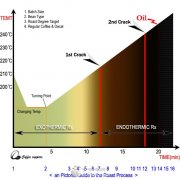
Analysis of roasting process of Coffee
Coffee roasting (coffee roasting) means that through heating raw beans, starch in raw beans is converted into sugars and acids at high temperature, substances such as cellulose will be carbonized to varying degrees, water and carbon dioxide will be volatilized, proteins will be converted into enzymes and fats, and the remaining substances will be combined to form an oil film on the surface of coffee beans, and in the process coffee acids will be formed.
Basic chemical reactions in the roasting process of coffee in both Chinese and English
Original: Basic Chemical Reactions Occurring in the Roasting Process by Carl Staub sourced from the SCAA Roast Color Classification System developed by Agtron-SCAA in 1995 Many thermal and chemical reactions occur during the roasting proces
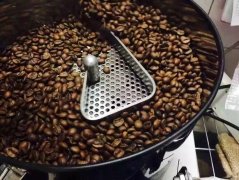
Explanation of the basic chemical reaction of coffee roasting in both Chinese and English
Original: Basic Chemical Reactions Occurring in the Roasting Process by Carl Staub sourced from the SCAA Roast Color Classification System developed by Agtron-SCAA in 1995 Many thermal and chemical reactions occur during the roasting proces
The whole process of coffee roasting technology
Coffee roasting (coffee roasting) means that through heating raw beans, starch in raw beans is converted into sugars and acids at high temperature, substances such as cellulose will be carbonized to varying degrees, water and carbon dioxide will be volatilized, proteins will be converted into enzymes and fats, and the remaining substances will be combined to form an oil film on the surface of coffee beans, and in the process coffee acids will be formed.